• Blueprint Bulletin
Your Senior Esthetician Seemed Fine Yesterday. Then She Quit.
The resignation that blindsided you started 6 months ago. Here's the MedSpa retention pattern most owners miss, and how to spot it early.
By Tamara C. Kelley | The Blueprint by Tam™ | June 11, 2026
She seemed fine yesterday. Then she gave two weeks' notice. Now you're scrambling.
I hear this from beauty and wellness leaders constantly. And here's the part that stings: by the time she gives notice, she already emotionally exited. You just didn't know it.
According to the American Med Spa Association's 2024 State of the Industry Report, the medical aesthetics industry has grown past $17 billion and added more than 1,500 new locations in a single year, about 18% growth. But here's what that growth conceals: 64% of medical spas saw medical director turnover in the past year.
That's not leadership shuffling. That's organizational instability wearing a growth costume.
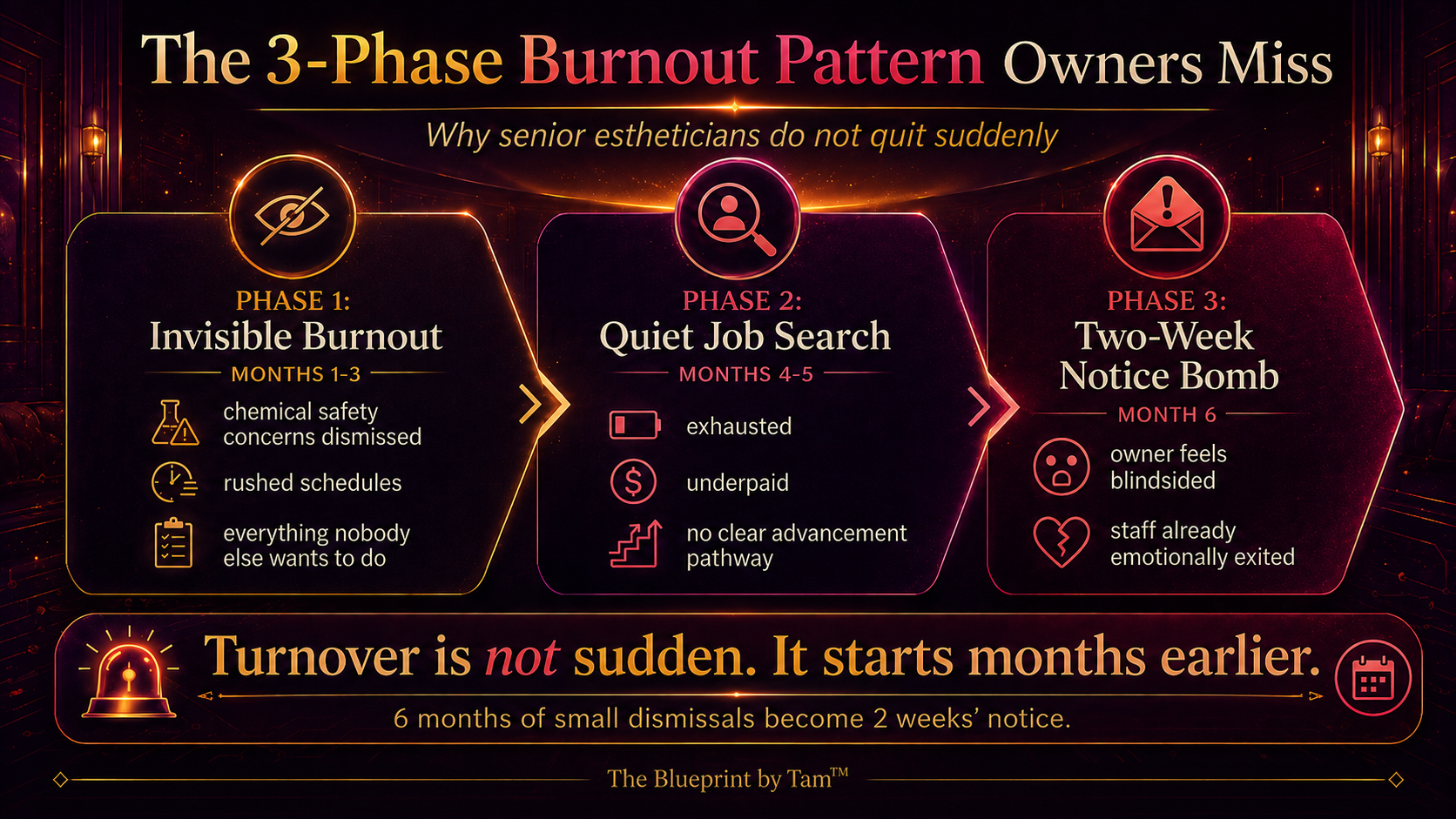
The resignation you're seeing today started as invisible burnout six months ago.
Why Do MedSpa Owners Keep Getting Blindsided By Staff Resignations?
When senior clinical staff give two weeks' notice, owners focus on immediate replacement: skills, certifications, availability. But what you're actually losing took 5 to 7 years to build and cannot be replaced in two weeks.
Here's what walks out the door with her, none of which is on a resume:
- Clinical judgment. The ability to read a client's skin, anticipate complications, and adjust in real time. That takes years to develop. You can't replace it with a certification course.
- Institutional memory. Which clients are difficult. Which vendors are reliable. Why you stopped using that product line. This knowledge doesn't live in your systems. It lives in her head.
- Culture stability. Senior staff set the tone and mentor new hires. When they leave, new hires don't know "how we do things here," because the person who knew just walked out.
You're not losing an employee. You're losing organizational resilience.
The Three-Phase Burnout Pattern
The beauty industry frames turnover as a "staffing shortage." But shortages are symptoms, not causes. Here's the real progression.
Phase 1: The Invisible Burnout (Months 1 to 3)
She's carrying chemical exposure symptoms, difficult clients, training duties, and covering understaffed shifts. Her job description says "esthetician." Her actual job is "everything nobody else wants to do." She doesn't report the strain, because she's watched how complaints get handled: "We're compliant. You're just sensitive."
Phase 2: The Quiet Job Search (Months 4 to 5)
She starts looking. Not because she hates you. Because she's exhausted and her body is telling her this environment isn't sustainable. She doesn't tell you, because she's seen what happens to people who give long notice.
Phase 3: The Two-Week Notice (Month 6)
She gives notice. You're blindsided. You ask why she didn't say something. She gives you the polite version: "I'm ready for a change." The real version is six months of concerns that got "we'll talk about it later."
What Research Shows Actually Works
According to healthcare workforce retention research from the Medical Group Management Association (MGMA), practices with lower turnover share three infrastructure patterns. These aren't perks. They're systematic changes to how the business operates.
Pattern 1: Workload Restructuring
MGMA's 2025 analysis found that lower-turnover practices built buffer time into scheduling instead of back-to-back appointments. In beauty and wellness, that looks like 10 to 15 minute buffers between clients, protected time for documentation, and booking expectations that don't require staff to rush. When staff feel "rushed," that's not a personality issue. It's a scheduling infrastructure problem. And rushed staff make mistakes, burn out, and start job searching.
Pattern 2: Non-Retaliatory Safety Reporting
Research on healthcare worker retention shows anonymous reporting channels raise psychological safety. Workplace data reinforces it: 42% of safety incidents go unreported due to fear. That means nearly half your problems are invisible until someone walks out. In medspas, this requires monthly anonymous pulse checks, specific questions about chemical exposure and ventilation, and demonstrated response, not just data collection.
Pattern 3: Transparent Compensation Systems
Labor research shows uncertainty about advancement is a stronger turnover predictor than base pay. Workers want to know the pay range for their current role, what the next level pays, and how to get there. When those answers live only in leadership's head, workers assume there's no pathway and leave to find one.
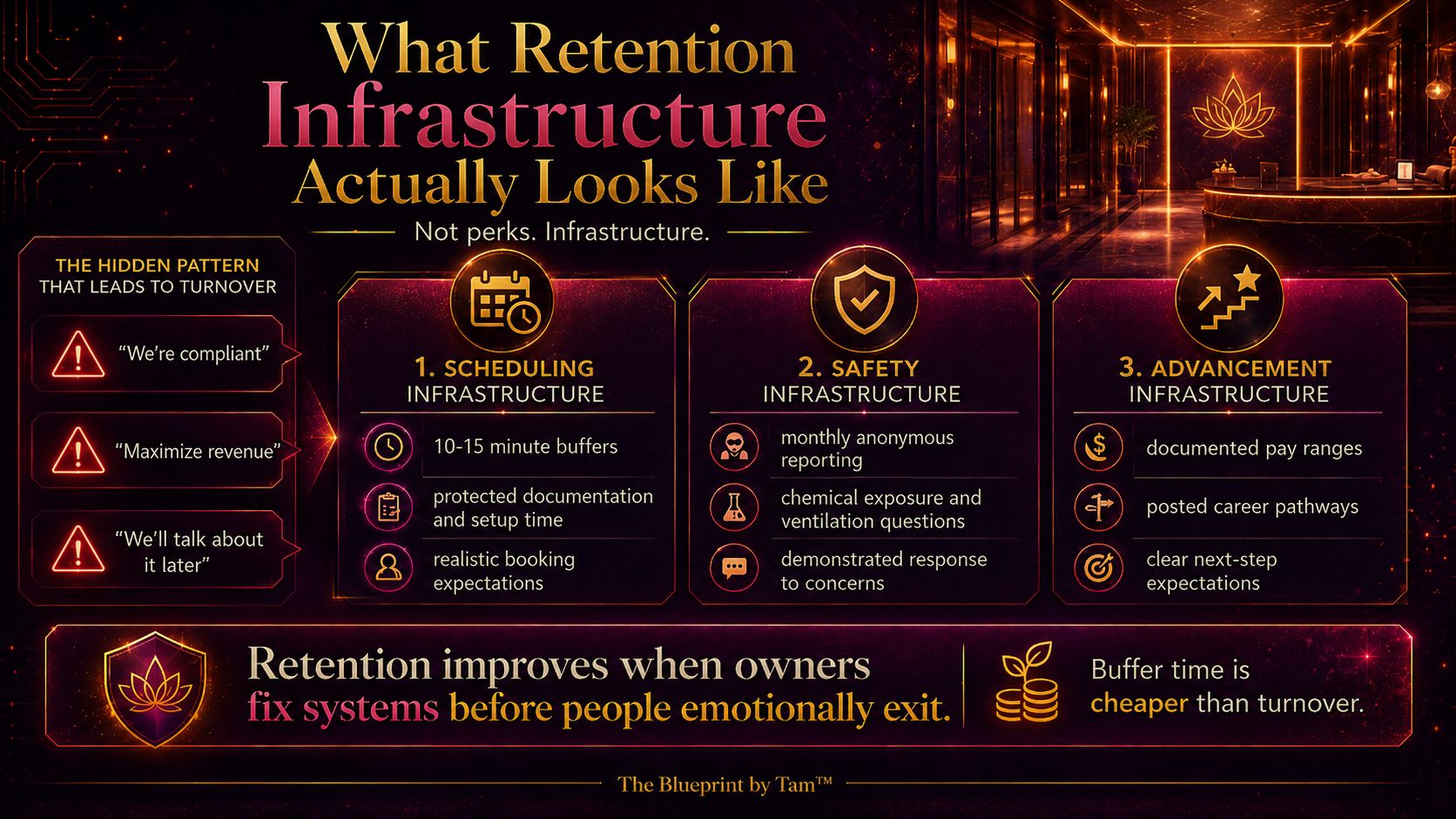
What retention infrastructure looks like: buffer time as standard procedure, anonymous reporting as monthly routine, and pay ranges documented and posted. The result isn't "zero turnover forever." It's "we see the warning signs early and address them before people emotionally exit."
Common Questions About MedSpa Staff Retention
Q: What is the retention pattern most medspa owners miss?
A: When senior clinical staff give two weeks' notice, owners focus on immediate replacement. But what is actually lost took 5 to 7 years to build: clinical judgment, institutional memory, and culture stability. The resignation is the end of a three-phase burnout pattern that started about six months earlier.
Q: What interventions actually reduce medspa staff turnover?
A: According to MGMA healthcare workforce retention research, lower-turnover practices share three infrastructure patterns: workload restructuring with buffer time between clients, non-retaliatory anonymous safety reporting with demonstrated response, and transparent compensation systems with documented pay ranges and advancement paths.
Q: How do we retain medspa staff without reducing booking density and losing revenue?
A: You are already losing revenue through turnover. Replacing a senior esthetician costs 6 to 9 months of productivity loss, training time, and the clients who leave when their preferred provider exits. Buffer time is cheaper than turnover.
Q: How do we know if our staff would be honest on anonymous surveys?
A: You don't, initially. Trust is earned through demonstrated response. When you ask about concerns and then actually address them, the next survey gets more honest answers. It is iterative.
Q: Doesn't retention infrastructure just create entitled employees?
A: No. It creates professional environments where clinical expertise is valued and protected. Framing retention as a favor instead of infrastructure is the mindset that creates turnover.